The average price per m² in Ajaccio is 3 959 €/m² for an apartment, within a range of 2,9 to 4,8 k€ per m², based on actual notarised (DVF) sales. Over the period, the market rose 9 % over 5 years and rose 1,5 % over the last 12 months, with about 660 transactions per year.

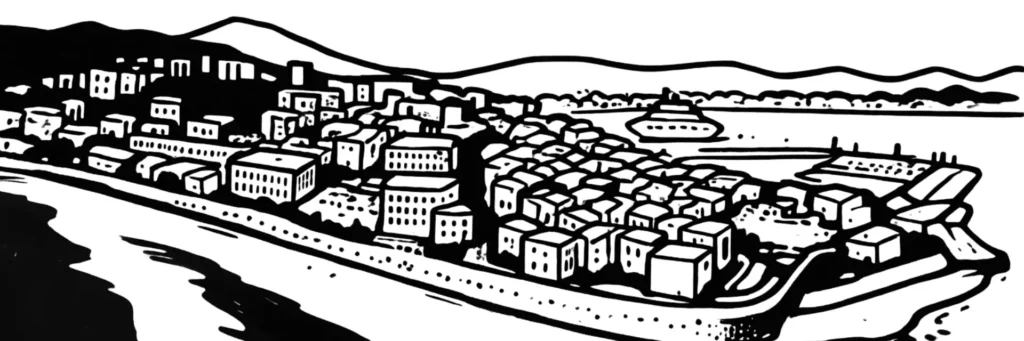
Illustration of Ajaccio, between the citadel, the harbour and the gulf.
Apartments in Ajaccio sell at an average price of around 3 959 €/m², based on transactions actually recorded (DVF data, the French database of notarised property sales). Prefecture of the Corse-du-Sud and the largest town on the island, Ajaccio stretches over 82 km² at the head of its gulf, from the pointe de la Parata in the west to the Ricanto plain in the east. Prices run from around 2 314 €/m² at Les Cannes, north of the centre, to 5 502 €/m² along the route des Sanguinaires. The town centre, the most active district along with the northern fringe, sits at around 4 029 €/m², and the old town of the Citadelle at around 4 874 €/m². The gap between the western coast and the northern districts is more than twofold, which makes the address decisive in a valuation. Houses, at around 4 489 €/m², change hands above apartments, on a markedly smaller volume.
Prices from the DVF file (Demandes de valeurs foncières, published by the DGFiP), transactions actually recorded at the notary at municipality level. Cross-referenced with the Notaires de France - INSEE indices. Learn more about our methodology.
After 3 627 €/m² in 2021, the average price in Ajaccio reaches 3 959 €/m² in 2026, roughly +9 % over the period.
Change in the average price per m² over twelve months, district by district, based on the most recent DVF sales.
The average price per m² for an apartment in each district of Ajaccio covered by Immover, ranked from the most expensive to the most affordable.
The Ajaccio market is that of an island prefecture of 76 000 inhabitants which concentrates the administrative, port and tourism functions of the Corse-du-Sud. With an average price of around 3 959 €/m² for an apartment, Ajaccio sits well above Bastia, the largest town of Haute-Corse, at around 2 933 €/m². Houses, at around 4 489 €/m², exceed apartments by around 13 %, but on only 71 sales over two years: the Ajaccio market remains an apartment market.
The gap between districts reflects the shape of the town, stretched from west to east. The western seafront, from Les Sanguinaires to Le Trottel, forms a market of its own, fed by second homes and little affected by local cycles: its curve has been almost flat for five years, at a high level. The old core and the retail centre follow, driven by scarcity and by holiday letting. The districts of the north and north-east, built between the 1960s and the present day, close the range, with contrasting paths: Pietralba and Mezzavia are up by around 20 % over five years, while Les Salines and Le Finosello are flat. With around 660 apartment sales a year, the town average is solid, but that of the least active districts, Les Cannes, Le Finosello and the Citadelle, varies from one year to the next.
With an average price of around 3 959 €/m², Ajaccio is the most expensive market in Corsica after the coastal towns of the south. Its standing as a prefecture and seat of the regional authority, its imperial heritage and its ten kilometres of seafront make it a town sought after both by island households and by second-home buyers.
Ajaccio occupies the head of its gulf, on the west coast of Corsica, sheltered by the mountains. The present town dates from 1492, when the Bank of Saint George founded a Genoese stronghold around the citadel. The old core is packed between the citadel rock, the place Foch and the harbour: it is there that Napoleon Bonaparte was born, on the rue Saint-Charles, in 1769, and there that the Notre-Dame-de-l'Assomption cathedral and the Palais Fesch stand.
In the nineteenth century, the town spread beyond its walls. The cours Napoléon and then the cours Grandval traced the two main axes of the centre, the place d'Austerlitz and the Casone monument marked the western exit, and European winter visitors had villas and hotels built on the south-western slopes, around Le Trottel, in what Ajaccio residents still call the foreigners' quarter. The route des Sanguinaires extends this seafront out to the pointe de la Parata.
The geography of prices follows this history. The western coast, from Les Sanguinaires to Parc Berthault, forms the top of the market, with developments from the 1960s to the present day facing the sea. The old town and the retail centre remain expensive and active. To the north and north-east, the districts built to house the growing town, from Les Cannes to Le Finosello and Les Salines, close the range. Between the two, Mezzavia, Pietralba and Aspretto benefit from recent developments and from new transport links.
The Ajaccio market combines two sets of buyers. On one side local households, working in regional public services, tourism, the port and the hospital, looking for a main residence in the districts of the north and the east. On the other side second-home buyers, from mainland France or islanders settled elsewhere, concentrated on the western coast and in the old town. That double demand explains both the high level of prices relative to local income and the wide gap between districts.
The average price in Ajaccio is 3 959 €/m² for an apartment (actual DVF transactions, notarised sales), within a range of 2 857 to 4 808 €/m² depending on the district. Listing portals show asking prices, 10 to 20 % above the prices actually recorded at signing.
No, and the gap is wide. The western coast is the most expensive area, at around 5 502 €/m² along the route des Sanguinaires and 5 193 €/m² at Parc Berthault. At the other end, Les Cannes sits at around 2 314 €/m² and Le Finosello at around 2 711 €/m². The town centre comes out at around 4 029 €/m² and the Citadelle at 4 874 €/m². From one end of the town to the other, the ratio is more than two to one.
Ajaccio brings together the functions of a prefecture and of the seat of the regional authority, an imperial and Genoese heritage, and a seafront of more than ten kilometres out to the pointe de la Parata. The town has a commercial and passenger port, the terminus station of the Corsican railways, the Napoléon-Bonaparte airport at Campo dell'Oro and, since October 2025, an urban cable car linking the seafront to the Mezzavia area.
Over five years, the DVF average for apartments has gone from around 3 627 €/m² to 3 987 €/m², a rise of around 9 %. The movement has clearly calmed over the last twelve months, at around 1,5 % growth. The gaps between districts remain more marked than the general trend: Le Trottel has risen by around 24 % over five years while Les Cannes fell by around 6 %.
The town average is not enough: you have to start from the price of your district, then adjust for the type of property, the storey, the condition, the aspect, the view over the gulf and the distance from the sea. On the western coast, beach access, a shared swimming pool or a terrace weigh heavily. The Immover valuation tool draws on the actual sales closest to your address.
This analysis is published by Immover, an independent observatory founded by Antony Barbier. Data sourced from official sources (DVF, INSEE, Notaries of France).