The average price per m² in Saint-Denis is 3 907 €/m² for an apartment, within a range of 2,9 to 4,7 k€ per m², based on actual notarised (DVF) sales. Over the period, the market fell 9 % over 5 years and fell 2,8 % over the last 12 months, with about 651 transactions per year.

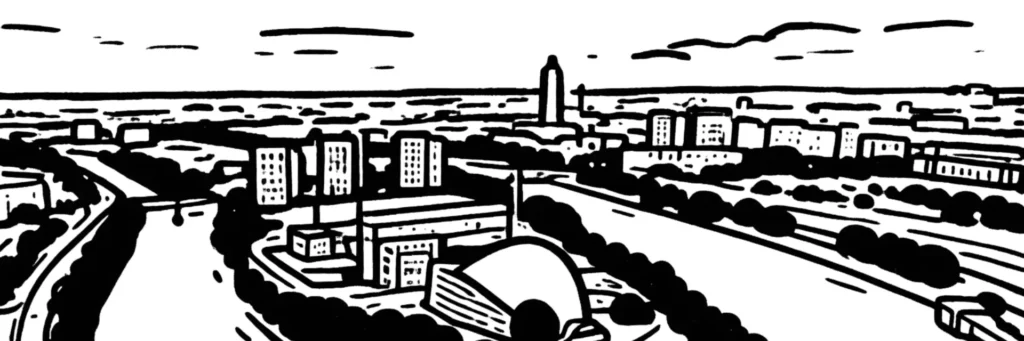
Illustration of Saint-Denis, in the Seine-Saint-Denis, between the basilica cathedral of the historic centre, the Stade de France, the redeveloped Plaine and the Pleyel transport hub.
Apartments in Saint-Denis sell at an average price of around 3 907 €/m², based on prices actually recorded (DVF data, the French notarised sales database). A sub-prefecture of the Seine-Saint-Denis, north of Paris, Saint-Denis is a town of sharp contrasts where the gaps between districts are marked. Prices run from around 2 783 €/m² in Delaunay-Belleville, to the north, the most affordable area, to nearly 4 952 €/m² in Pleyel, to the south-west, driven by the major Grand Paris Express hub. The house market sits at around 4 809 €/m², town houses holding a smaller place in a dense town. Over five years apartment prices have fallen by around 9 %, after the 2021 peak, and the town records around 651 apartment sales a year.
Prices from the DVF file (Demandes de valeurs foncières, published by the DGFiP), transactions actually recorded at the notary at municipality level. Cross-referenced with the Notaires de France - INSEE indices. Learn more about our methodology.
After 4 273 €/m² in 2021, the average price in Saint-Denis reaches 3 907 €/m² in 2026, around -9 % over the period.
Change in the average price per m² over twelve months, district by district, based on the most recent DVF sales.
The average price per m² for an apartment in each district of Saint-Denis covered by Immover, ranked from the most expensive to the most affordable.
The Saint-Denis market is that of an inner suburb north of Paris, more affordable than the capital but carried by major transport and regeneration projects. With an average price of around 3 907 €/m² for an apartment, Saint-Denis sits well below Paris, at the level of a dense town of the Seine-Saint-Denis. Over five years apartment prices have fallen by around 9 %, after the 2021 peak, and the town records around 651 apartment sales a year, not counting a house market at around 4 809 €/m².
Geography draws the price map. Pleyel, to the south-west, around the major Grand Paris Express hub, and the Plaine Saint-Denis, turned towards the Stade de France and the offices, hold the most highly rated areas. The historic centre, around the basilica and the market, and Porte de Paris form an intermediate core of the market. Franc-Moisin and Joliot-Curie, to the east and south, along with le Champ de Courses and Delaunay-Belleville, to the south-east and north, remain the most affordable areas in the town.
With an average price of around 3 907 €/m², Saint-Denis sits well below Paris, at the level of an inner suburb to the north. Its basilica cathedral, its market, the redevelopment of the Plaine Saint-Denis and the arrival of the Grand Paris Express at Pleyel make it a sought-after town for the proximity of the capital and the potential of its major projects.
Saint-Denis is a town in the Seine-Saint-Denis, north of Paris, sub-prefecture of a department whose prefecture is Bobigny. Its history is that of a great religious and industrial centre: the basilica cathedral of Saint-Denis, a masterpiece of Gothic art, holds the burial place of the kings of France, while the Plaine Saint-Denis was one of the great industrial areas of the Île-de-France before its redevelopment.
The historic centre is laid out around the basilica, the town hall and one of the largest markets in the Île-de-France, on the place du Caquet and the rue Gabriel-Péri. To the south, the Plaine Saint-Denis, a former industrial district, has been transformed into a business district housing head offices, media companies and the Stade de France. The Paris 8 Vincennes-Saint-Denis university and the canal Saint-Denis complete the urban fabric of the town.
The town is now carried by major transport and regeneration projects. The Saint-Denis - Pleyel station hub brings together the Grand Paris Express lines (13, 14, 15, 16 and 17), tram lines T1 and T8 serve the districts, and RER lines B and D link the town to Paris. The property market bears the mark of this: Pleyel and la Plaine are gaining value with the projects, while the districts of the north and east remain markedly more affordable.
The Saint-Denis market attracts first-time buyers, families, people working in Paris or in the business hubs of la Plaine and Pleyel, and investors. Demand focuses on apartments in the centre around the basilica, on the new-build schemes of Pleyel and la Plaine, and on the more affordable housing of the north of the town. Prices, more accessible than those of Paris itself, remain sought after for the proximity of the capital and the arrival of the Grand Paris Express.
The average price in Saint-Denis is 3 907 €/m² for an apartment (actual DVF transactions, notarised sales), within a range of 2 898 to 4 696 €/m² depending on the district. Property portals show asking prices, 10 to 20 % above the prices actually recorded.
No. Pleyel, to the south-west, driven by the major Grand Paris Express hub, sits at the upper end of the range, at around 4 952 €/m², while Delaunay-Belleville, to the north, remains the most affordable area, at around 2 783 €/m². The centre around the basilica and la Plaine make up an intermediate core of the market.
Pleyel is home to Saint-Denis - Pleyel station, one of the largest interchange hubs of the Grand Paris Express, and to a district in full transformation, between offices, new-build schemes and the conversion of the 2024 Olympic village. That project momentum supports prices above the town average.
Over five years apartment prices have fallen by around 9 %, after the 2021 peak, in a correction seen across part of the Île-de-France market. The market remains active, with around 651 apartment sales a year, and the transport projects support certain areas.
The town-wide average price is not enough: you have to start from the price in your own district, then adjust for the type of property (house or apartment), the floor, the condition, the aspect and how close you are to public transport. The Immover valuation tool draws on the actual sales closest to your address.
This analysis is published by Immover, an independent observatory founded by Antony Barbier. Data sourced from official sources (DVF, INSEE, Notaries of France).